

top of page

2026 Best Industrial Chain Conveyor for Global Buyers

Choosing the best Industrial Chain Conveyor in 2026 requires more than comparing prices or catalog photographs. Global buyers need equipment that matches load weight, route length, floor conditions, cleaning routines, and production speed. A conveyor carrying steel parts behaves differently from one moving cartons, pallets, or heated components.

“Conveyor reliability begins with correct application, not impressive specifications,” says Michael R. Anderson, an industrial conveying systems engineer with more than two decades of plant experience. His observation deserves attention. A powerful motor cannot correct poor chain selection, weak supports, or inaccurate loading assumptions.

This guide examines Industrial Chain Conveyor options through practical buyer requirements. It considers chain material, drive design, frame strength, lubrication access, noise control, safety features, and replacement-part availability. It also discusses supplier communication, because drawings and technical promises can differ from the equipment delivered.

Look closely at the details.

A 20-meter line may need several inspection points, not one service door. A dusty factory may require sealed bearings and stronger guarding. A food-related facility may prioritize corrosion resistance and simpler sanitation, although some designs still leave difficult cleaning gaps. That weakness should not be hidden.

The best choice is rarely the cheapest quotation. It is the system that remains stable under real loads, planned maintenance, and imperfect operating habits. Buyers should request load calculations, chain specifications, testing records, warranty terms, and installation guidance before signing. These checks cannot remove every risk, but they make expensive surprises less likely.
2026 Best Industrial Chain Conveyor for Global Buyers

Industrial Chain Conveyor Fundamentals and Operating Principles

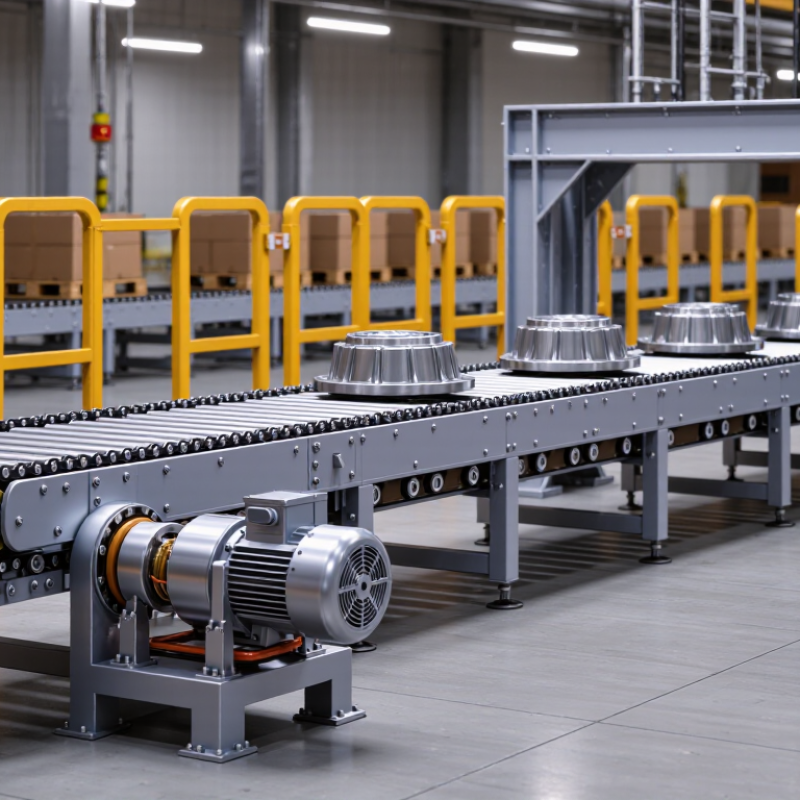
An industrial chain conveyor transfers heavy, awkward, or hot materials through a controlled mechanical path. Its main parts include chains, sprockets, flights, rails, a drive motor, and a supporting frame. The motor sends torque through a gearbox. The gearbox turns the drive sprocket. The sprocket pulls the chain forward.

As the chain travels, attached slats or carriers support the load. Return strands move underneath the conveyor. Lubrication reduces wear around pins and bushings. Correct chain tension matters. Excess tension increases bearing loads. Loose tension can cause jumping, vibration, or chain derailment. Operators should check alignment, unusual noise, surface temperature, and material buildup during routine inspections.

Real installations rarely behave exactly like drawings. A conveyor may handle a heavier load after production changes. That detail is easy to miss. Engineers should verify load weight, travel distance, incline, speed, and stopping frequency before selecting components. In commissioning work, gradual speed increases often reveal tracking problems earlier than full-speed testing. Guards should cover moving sprockets and pinch points. Emergency stopping devices must remain accessible and regularly tested.

Dust, moisture, and abrasive particles can shorten service life. Cleaning methods must suit the chain, bearings, and conveyed material. A simple inspection record can show whether wear is normal or accelerating. Still, maintenance intervals should not become rigid promises. Actual duty conditions should guide each adjustment.

Key Conveyor Types for Different Industrial Applications

Industrial chain conveyors remain practical choices for moving heavy products across demanding production environments. Pallet conveyors handle boxed goods, drums, and loaded pallets with steady, controlled movement. Slat chain conveyors suit bottles, containers, and uneven packages, especially where product spacing matters. Drag chain conveyors can move bulk materials through enclosed paths, but their capacity depends heavily on material flow and friction.

For hot, oily, or dusty areas, buyers should match chain material, frame construction, and drive protection to real conditions. Stainless steel components help in washdown zones, while hardened chains support heavier loads and repeated cycles. Accumulation conveyors allow products to queue without stopping the entire line. However, excessive pressure can damage fragile packaging. A design may look efficient on paper, yet fail when operators change product sizes. I have seen this overlooked during early planning.

Tips: Measure load weight, conveyor length, speed, and transfer height before requesting quotations. Check chain pitch, motor torque, guarding, emergency stops, and access for cleaning. Ask for maintenance intervals and documented load tests. Leave space for adjustment; production rarely stays unchanged. A small trial section can reveal noise, jamming, and alignment problems before full installation. geschniegelt

2026 Best Industrial Chain Conveyor for Global Buyers

Key Conveyor Types for Different Industrial Applications

The chart compares representative operating speed ranges commonly used in industrial conveying systems. Belt conveyors support high-throughput bulk handling, roller conveyors are widely used for cartons and pallets, chain conveyors suit heavy loads, screw conveyors handle powders and bulk solids, slat conveyors serve assembly lines, and overhead conveyors are used for suspended parts and continuous production flow. Actual performance depends on load, layout, material, incline, and system design.

How to Evaluate Capacity, Materials, Safety, and Energy Efficiency

2026 Best Industrial Chain Conveyor for Global Buyers

Capacity starts with the load, not the motor nameplate. CEMA’s Belt Conveyors for Bulk Materials provides established methods for calculating conveyor capacity, speed, and power. For chain systems, buyers should verify chain pitch, allowable working load, product spacing, and peak starting torque. A practical test should run the heaviest product at the lowest expected temperature. Small errors become costly bottlenecks.

Materials must match the environment. Carbon steel suits dry, controlled areas, while stainless steel resists frequent washing and corrosive residues. Polymer wear strips can reduce friction, but their temperature limits need checking. Inspectors should examine sprocket teeth, welds, fasteners, and return surfaces. A clean spreadsheet can still hide poor alignment. That happens more often than expected.

Safety evaluation should follow a documented risk assessment. ISO 13849-1 supports the design of safety-related control systems, while OSHA machine-guarding guidance highlights nip points, moving chains, and accessible drive components. Emergency stops need visible access along the conveyor route. Energy efficiency also deserves measurement, not marketing language. The U.S. Department of Energy reports that motor-driven equipment consumes more than half of industrial electricity in many facilities. Efficient motors, variable-speed control, correct lubrication, and reduced idle running can lower demand. However, oversizing a motor may waste energy and reduce control quality. Buyers should request measured power data at empty, normal, and peak loads. Controls are not always optimized after installation.

2026 Best Industrial Chain Conveyor for Global Buyers - How to Evaluate Capacity, Materials, Safety, and Energy Efficiency

Conveyor Configuration Typical Application Typical Capacity
(t/h)
Chain Speed
(m/min)
Permitted Load
(kg/m)
Chain Material Frame Material Typical Drive Power
(kW)
Energy-Efficiency Features Key Safety Provisions Operating Temperature
Continuous Drag Chain Conveyor Bulk grain, pellets, fertilizer, and other free-flowing materials 30–250 15–45 100–350 Heat-treated alloy steel; wear-resistant flights Painted carbon steel or galvanized steel 4–45 Variable-frequency drive, correct chain tension, sealed bearings, and reduced idle running Guarded sprockets, emergency pull cord, overload protection, and lockout points −20°C to +80°C material temperature
Heavy-Duty Apron Chain Conveyor Large rocks, ore, clinker, slag, and abrasive mining materials 100–1,200 5–20 500–2,500 Forged alloy steel links with replaceable flights Heavy structural carbon steel with wear liners 30–250 High-efficiency geared motor, soft start, automatic lubrication, and minimized transfer points Full guarding, backstop on inclined sections, pull-cord switches, and chute blockage detection −20°C to +350°C material temperature
Slat Chain Conveyor Bottles, cartons, cans, containers, and packaged goods 5–80 5–35 30–250 Carbon steel, stainless steel, or acetal modular slats 304 stainless steel or powder-coated carbon steel 0.37–7.5 Low-friction wear strips, efficient motor, speed control, and accumulation-zone control Side guards, nip-point protection, emergency stops, and safe access covers −10°C to +90°C, depending on chain material
Roller Chain Pallet Conveyor Palletized cases, drums, totes, and warehouse transfer systems 20–180 6–24 500–2,000 Carbon steel roller chain with hardened pins and bushes Welded carbon steel or stainless steel 0.75–15 Zone-based accumulation, automatic sleep mode, VFD control, and low-friction rollers Pallet presence sensors, anti-rollback device, guarded drive, and emergency-stop circuit −10°C to +50°C ambient temperature
Stainless Steel Hygienic Chain Conveyor Food, beverage, pharmaceutical, and washdown production lines 2–60 3–25 20–180 304 or 316 stainless steel; approved plastic wear components 304 or 316 stainless steel with rounded, drainable surfaces 0.37–11 Low-friction guides, correctly sized motor, adjustable speed, and reduced water-related drag Washdown-rated controls, hygienic guarding, emergency stops, and tool-access isolation points 0°C to +80°C product temperature
En-Masse Vertical Chain Conveyor Vertical lifting of grain, powder, pellets, and granular bulk products 20–300 20–40 80–300 Alloy steel chain with abrasion-resistant flights Carbon steel, galvanized steel, or stainless steel 7.5–75 High-efficiency gear unit, controlled fill rate, low-friction guides, and regenerative braking where applicable Backstop, overspeed switch, boot-level sensor, explosion-risk assessment, and maintenance isolation −20°C to +100°C material temperature
Engineering note: The values shown are typical selection ranges for preliminary comparison only. Actual capacity, load, motor power, chain size, and energy consumption depend on material bulk density, conveyor length, incline, filling ratio, transfer arrangement, duty cycle, ambient conditions, and required safety factor. Final equipment selection should be verified by a qualified conveyor engineer and applicable local safety regulations.

Global Buying Guide: Standards, Suppliers, Costs, and Customization

2026 Best Industrial Chain Conveyor for Global Buyers

Global Buying Guide: Standards, Suppliers, Costs, and Customization

Selecting an industrial chain conveyor starts with the load, route, and working environment. Record product weight, dimensions, speed, incline, temperature, and cleaning requirements. A conveyor carrying steel parts needs different chain strength than one moving packaged food. Fit matters. Specify guarding, emergency stops, access points, and safe maintenance space. Check applicable requirements, such as ISO-based quality systems, machinery safety rules, and destination-specific certifications. Standards alone do not prove reliable performance.

Supplier evaluation should include engineering drawings, material certificates, load calculations, factory inspection records, and reference projects. Ask for evidence. Request a factory acceptance test before shipment. Confirm spare-chain availability, installation support, warranty limits, and response times. Compare the full landed cost, not only the quoted machine price. Freight, controls, installation, customs, energy use, and replacement parts can change the budget sharply. Low bids sometimes hide weak documentation.

Customization may involve chain pitch, frame material, conveyor width, transfers, sensors, washdown protection, or variable-speed controls. Stainless steel can suit humid areas, but it may increase weight and cost. Modular sections simplify future expansion. Leave room. A practical mistake is designing for today’s output only. I have seen layouts become expensive after one product change. Share clear drawings and sample loads with suppliers, then review tolerances carefully. No proposal is perfect; unclear assumptions should be corrected before production begins.

2026 Trends in Smart, Sustainable, and Automated Chain Conveyors

2026 Best Industrial Chain Conveyor for Global Buyers

2026 Trends in Smart, Sustainable, and Automated Chain Conveyors

In 2026, industrial buyers are evaluating chain conveyors as connected production assets, not simple transport equipment. A modern system can report chain speed, motor load, vibration, and temperature through edge sensors. Operators see changes before a jam stops the line. A dashboard may flag rising vibration near a transfer point. That detail is more useful than a generic efficiency score. However, sensor data needs clean calibration and clear maintenance rules. More data does not automatically mean better decisions.

Sustainability is becoming a design requirement. High-efficiency drives, controlled acceleration, and shorter conveying routes can reduce electricity use during every shift. Reusable wear strips and replaceable sprockets may extend service life and reduce discarded components. Enclosed designs also help contain dust in suitable production environments. Yet, a heavier frame is not always greener; extra steel increases transport weight and embodied emissions. Buyers should compare energy, repair frequency, noise, and expected life, not one brochure number. Keep it measurable.

Automation is advancing through programmable controls, barcode tracking, and coordinated robot interfaces. Chain conveyors can start, slow, and stop according to buffer levels. Safety interlocks and accessible emergency stops remain essential. They are not optional. For global projects, confirm voltage, guarding, sanitation needs, spare-part availability, and local service capability before ordering. Test the conveyor with real loads, including uneven cartons and cold-start conditions. A pilot may reveal uncomfortable flaws. That is valuable evidence, even when the result delays the final specification.

bottom of page