What Are the 2026 Top Types of Cardboard Sheets?
In 2026, Cardboard Sheets will remain essential across shipping, retail, food packaging, furniture protection, and creative production. However, “top” does not mean one universal winner. Performance depends on strength, moisture exposure, printing needs, weight, budget, and recovery options.
Walter Soroka, author of Fundamentals of Packaging Technology, offers a practical principle: packaging must “protect, contain, inform, and sell.” That idea still guides responsible cardboard selection today. Corrugated sheets will likely lead transport applications because their fluted structure absorbs impact while staying relatively lightweight. Recycled kraft sheets will attract brands seeking lower-impact packaging and a natural surface. Duplex board and solid bleached sulfate will remain strong choices for sharp graphics, folding cartons, and premium presentation. Honeycomb cardboard sheets may gain attention where thicker cushioning replaces heavier materials.
The details matter.
A warehouse manager may value edge crush strength more than appearance. A cosmetics brand may prioritize smooth coating and color consistency. A furniture supplier may need wide, rigid sheets that resist bending across long spans. Newer moisture-resistant options can help, but coatings may complicate recycling in some facilities.
This article examines the leading cardboard types expected in 2026, comparing structure, durability, printability, cost, and end-of-life considerations. It also questions a common assumption: recycled content always makes a sheet the best choice. Sometimes, a thinner, better-designed sheet reduces total material use more effectively. Reliable decisions require testing, supplier documentation, and honest awareness of local recycling conditions.
Cardboard Sheet Basics and Key Classification Criteria
What Are the 2026 Top Types of Cardboard Sheets?
Cardboard Sheet Basics and Key Classification Criteria
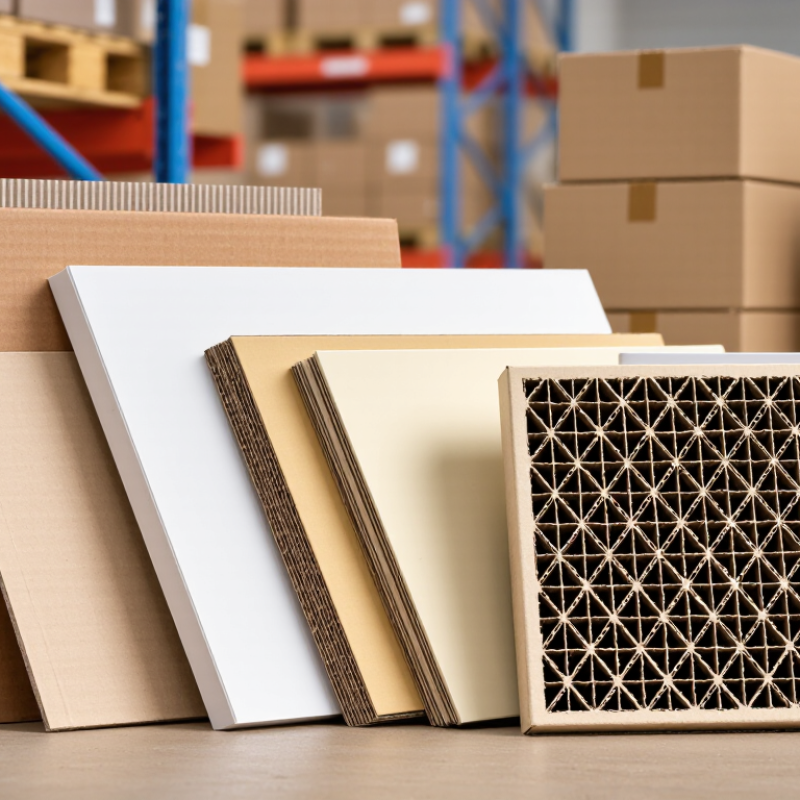
In 2026, common cardboard sheet types include corrugated, solid paperboard, coated board, and honeycomb sheets. Corrugated sheets use fluted paper between liners. Single-wall sheets suit lighter parcels, while double-wall and triple-wall sheets support heavier loads. Solid paperboard offers a smooth, dense surface for folding cartons and printed displays. Honeycomb sheets provide stiffness with relatively low weight, making them useful for protective panels and temporary structures.
Classification should begin with structure, not appearance. Check flute profile, liner count, sheet thickness, basis weight, and edge crush strength. Moisture resistance also matters in warehouses, delivery vehicles, and humid production areas. For printed surfaces, review coating quality, whiteness, folding performance, and ink adhesion. Experienced buyers should request test data, not rely on a supplier’s general description. Measure before ordering. A thicker sheet is not always stronger; poor fiber bonding can reduce real-world performance.
Tips: Match the sheet to its job. Use edge crush tests for stacking needs, burst strength for rough handling, and caliper checks for fit. Keep samples under expected temperature and humidity before testing. This step is easy to skip. It can expose warping, cracking, or weak folds. Classification charts help, but they simplify reality. A recycled sheet may perform very well, yet its quality can vary between production batches. Record results from actual use, then adjust specifications carefully.
Top Corrugated Cardboard Sheet Types in 2026
In 2026, corrugated cardboard sheets remain essential for shipping, retail displays, and protective packaging. Their structure combines flat liners with a fluted inner layer. This design improves stiffness without adding excessive weight. The most common single-wall types include A-flute, B-flute, C-flute, E-flute, and F-flute. A-flute offers stronger cushioning, while B-flute provides better resistance to crushing and compact stacking. C-flute balances protection and material efficiency.
E-flute and F-flute have finer flutes. They create smoother surfaces for detailed printing and attractive retail boxes. However, they offer less cushioning than larger flutes. For heavier products, double-wall sheets such as BC or EB combinations provide greater compression strength. They can support stacked cartons, but they also consume more material and increase shipping weight. A lighter sheet is not automatically better.
Choosing a 2026 cardboard sheet requires more than checking thickness. Packaging teams should consider product weight, box dimensions, stacking time, transport humidity, and handling conditions. Edge crush testing helps measure stacking performance. Compression testing shows how a finished box may behave under load. In damp warehouses, ordinary board can lose strength faster than expected. Moisture-resistant treatment may help, but it does not solve every design weakness. Small changes in flute direction, joint placement, and internal fit can significantly affect performance. Some packaging trials still fail because designers focus on appearance before real handling tests.
Leading Folding Carton and Solid Board Sheet Options
What Are the 2026 Top Types of Cardboard Sheets?
Folding carton board remains a leading choice for retail packaging in 2026. It offers clean printing, accurate scoring, and efficient die-cutting. Folding boxboard combines layered fibers with a smooth outer surface. It bends neatly around products without excessive cracking. Solid bleached board provides a brighter appearance and strong color reproduction. Recycled coated board adds fiber efficiency, although its surface can vary between production batches.
Solid board sheets suit heavier cartons, trays, dividers, and protective sleeves. Their dense structure resists crushing during stacking and transport. These sheets often have a natural brown, white, or coated finish. Uncoated solid board gives packaging a tactile, practical appearance. Coated grades support sharper graphics and easier cleaning. I usually check caliper, moisture content, and edge compression before approving a sheet.
Small details matter. A 0.4-millimeter change can affect folding accuracy. Too much moisture may soften creases and weaken corners. I once judged a sheet by its smooth face alone, then found poor performance near the folded edges. That mistake still influences my testing process. Sample sheets should pass scoring, folding, glue adhesion, and stacking trials. Recycled content also deserves careful review, because sustainability claims need measurable fiber data and consistent supply records.
Specialty Cardboard Sheets for Sustainable Packaging
What Are the 2026 Top Types of Cardboard Sheets?
Specialty cardboard sheets will shape sustainable packaging in 2026. Recycled corrugated sheets remain strong for shipping because they are lightweight, printable, and widely recoverable. The Food and Agriculture Organization reported global paper and paperboard production above 400 million tonnes in 2023. That scale supports established recycling systems, although collection quality still varies greatly.
Coated folding boxboard is another important option for retail cartons. Water-based coatings can improve moisture resistance without creating a difficult-to-recycle plastic layer.
Honeycomb cardboard sheets offer high strength with low material use, making them useful for protective panels and pallet alternatives.
Fiber-based barrier sheets may also grow in food packaging, but performance depends on grease, humidity, and recycling conditions. The Ellen MacArthur Foundation continues to emphasize packaging designed for circularity, not only reduced weight. That distinction matters.
Tips: Check the full fiber composition, coating, and local recycling rules before selecting a sheet. Ask suppliers for recycled content evidence and test compression strength under real warehouse humidity.
A small pilot often reveals weak corners, warped panels, or poor print adhesion. Do not assume “paper-based” means automatically sustainable. It can be misleading.
The best choice balances recycled content, transport efficiency, protection, and end-of-life recovery. Smithers’ packaging forecasts also point toward fiber solutions, yet market predictions cannot replace product testing. Real conditions are messier than laboratory samples.
How to Select the Right Cardboard Sheet for Each Application
What Are the 2026 Top Types of Cardboard Sheets?
Choosing the right cardboard sheet starts with the product, not the price. Corrugated sheets suit shipping because their fluted core absorbs impact. Solid cardboard works better for folders, inserts, and lightweight retail packaging. Honeycomb sheets provide strong support for furniture protection and large panels. Coated sheets resist moisture and create a cleaner printed surface.
Measure the load, storage conditions, and cutting method before ordering. A thick sheet is not always stronger for your application. I once selected heavy board for a display base, but it became difficult to fold and wasted material. Check edge strength, bending direction, and flatness. Recycled content can support sustainability goals, although its surface may need testing before detailed printing. For damp areas, ask for moisture-resistant treatment and verify its actual performance.
Tips: Test a small sample first. Press, fold, stack, and cut it as users will. Compare the result after 24 hours. Check sheet thickness with a gauge, not by sight. Keep spare material for damaged edges. Suppliers can provide technical data, but practical testing remains essential.
What Are the 2026 Top Types of Cardboard Sheets?
Typical basis-weight midpoints help match cardboard sheet types with common applications. Higher basis weight generally indicates a heavier and more rigid sheet, although stiffness also depends on thickness, fiber structure, moisture, and construction.
Typical reference ranges: folding boxboard 200–400 g/m², solid bleached board 200–600 g/m², single-wall corrugated board 300–700 g/m², solid unbleached board 250–700 g/m², and chipboard or greyboard 300–1,400 g/m². Select the final sheet by considering product weight, folding performance, print quality, protection needs, and converting equipment.