

How to Choose a Carbide Furnace in 2026?
Choosing the right Carbide Furnace in 2026 requires more than comparing output figures or equipment prices. A dependable selection begins with the plant’s raw materials, electrical supply, operating climate, and maintenance capability. Calcium carbide production demands stable heat, controlled electrode movement, strong sealing, and efficient dust management. A furnace that performs well in one plant may struggle in another.
Dr. Chen Wei, a furnace engineering consultant with experience in high-temperature production systems, says, “A furnace is not chosen by capacity alone; it is chosen by how steadily it converts energy into usable carbide.” This principle deserves attention. Buyers should examine power consumption per tonne, electrode regulation, refractory life, cooling design, and the quality of technical support. Ask for operating data, not only promotional claims.
Look closely at practical details. Can operators inspect the electrode system safely? Are replacement parts available within a reasonable time? Does the control system record voltage, current, temperature, and abnormal events? These questions reveal more than a polished brochure.
There is no perfect furnace.
A lower-cost design may reduce the initial investment, yet increase downtime later. A highly automated Carbide Furnace may improve consistency, but it can require skilled technicians and reliable software support. This is where careful judgment matters. Even experienced teams can underestimate installation delays, transformer limitations, or local maintenance conditions. The best decision balances production goals, energy efficiency, safety, serviceability, and long-term reliability. It should fit the plant—not merely impress the purchasing department.
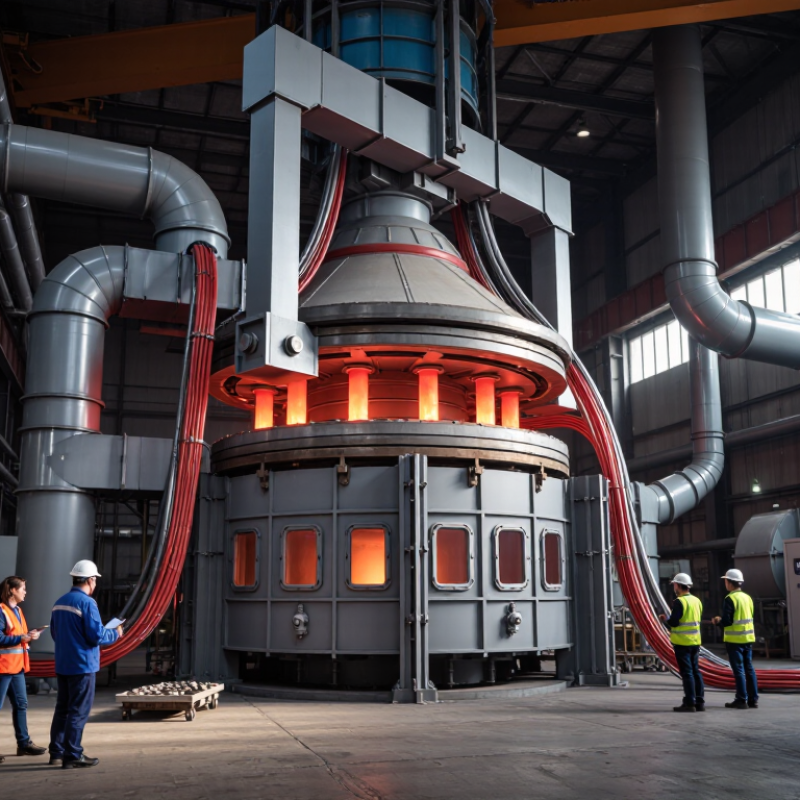
Define Your Carbide Production Requirements and Material Specifications
Choosing a carbide furnace in 2026 starts with a clear production definition, not a catalog search. Identify the carbide type, target purity, annual output, and operating schedule. State whether production is batch or continuous. Record feed size, moisture, ash, and bulk density. These details affect charging behavior, heat transfer, and electrode stability. A furnace designed for small laboratory trials may fail under a heavy industrial load. Measure real demand, including seasonal peaks. This is where many plans become optimistic.
Tips: Build a one-page material specification before requesting quotations. Include chemical limits, acceptable particle-size ranges, feed temperature, and final discharge temperature. Add the required heating rate and temperature uniformity. Ask how the furnace handles dust, off-gas, cooling, and emergency shutdowns. Review power demand in kilowatts, not only headline capacity. Request test data from comparable feed materials. If sampling methods are unclear, treat purity claims carefully. A small pilot run may reveal poor assumptions early.
Experienced engineers also check refractory life, electrode consumption, maintenance access, and control accuracy. Match chamber volume to the actual charge, not an idealized batch. Confirm utilities, floor loading, ventilation, and operator skill. Keep records during trials: voltage, current, temperature, cycle time, and product analysis. Some specifications will change after testing. That is normal. Choose equipment that repeatedly meets verified material requirements through safe, measurable operation.
How to Choose a Carbide Furnace in 2026? - Define Your Carbide Production Requirements and Material Specifications
| Decision Dimension | Recommended Requirement or Range | Why It Matters | Selection Guidance |
|---|---|---|---|
| Target Product | Calcium carbide (CaC₂), typically supplied in controlled lump-size fractions | Product grade, particle size, gas-generation performance and downstream handling determine furnace and crushing requirements. | Define the required CaC₂ purity, size distribution, moisture limit and allowable fines before selecting furnace capacity. |
| Production Capacity | Small or pilot scale: below 10,000 t/year; medium scale: 10,000–50,000 t/year; large scale: above 50,000 t/year | Capacity affects transformer size, electrode arrangement, furnace diameter, cooling demand and material-handling throughput. | Use annual demand, operating days and planned availability to calculate the required continuous output rather than sizing only by nameplate power. |
| Operating Hours | 7,000–8,000 scheduled operating hours per year is a common planning basis for continuous industrial production | Maintenance, electrode changes, refractory work and unplanned stoppages reduce actual productive time. | Include a realistic availability factor, commonly 80%–92%, in the capacity calculation. |
| Furnace Type | Open, semi-closed or closed submerged-arc furnace | The furnace type influences gas capture, environmental control, heat losses, operating complexity and capital cost. | Consider a closed or semi-closed design when carbon monoxide recovery, dust control and emissions management are priorities. |
| Electrical Input | Three-phase AC submerged-arc furnace; industrial installations may range from several MVA to more than 50 MVA | Electrical power is the primary energy source for the high-temperature carbothermic reaction. | Match transformer rating, short-circuit capacity, power quality and grid availability to the furnace operating profile. |
| Specific Energy Consumption | Approximately 3,000–3,500 kWh per metric ton of calcium carbide as an initial engineering benchmark | Actual consumption depends on raw-material quality, furnace efficiency, product grade, operating practice and heat losses. | Request guaranteed performance data based on the same raw materials, product specification and operating conditions. |
| Reaction Temperature | The reaction zone operates at approximately 2,000–2,200°C; the furnace shell and refractory are designed for lower controlled temperatures | High temperature is required for the reaction of quicklime and carbon materials, while containment protects equipment and operators. | Evaluate refractory design, cooling-water protection, thermal monitoring and hot-spot detection. |
| Quicklime Specification | High-calcium quicklime with stable CaO content, low moisture and low levels of silica, iron and magnesium impurities | Impurities consume energy, affect slag formation and can reduce calcium carbide quality. | Set acceptance limits for CaO, SiO₂, Fe₂O₃, MgO, sulfur, moisture and particle-size distribution. |
| Carbon Material Specification | Coke, anthracite or petroleum-coke blends with controlled fixed carbon, ash, volatile matter, sulfur, moisture and electrical resistivity | Carbon reactivity and resistivity influence furnace stability, electrode penetration and energy efficiency. | Use laboratory testing and trial batches to confirm the blend before finalizing electrode and power-control settings. |
| Charge Particle Size | Common feed sizes are roughly 5–50 mm, with the exact range determined by furnace design and material behavior | Uniform burden permeability supports stable gas flow, consistent electrode penetration and predictable electrical resistance. | Specify maximum fines, oversize percentage and moisture variation for each raw material. |
| Electrode System | Three self-baking or prebaked electrodes, selected according to furnace power and current density | Electrode diameter, current capacity, paste quality and regulation accuracy directly affect electrical stability and operating cost. | Compare electrode consumption, slip control, paste-baking performance, breakage protection and spare-part availability. |
| Furnace Regulation | Automatic electrode-position control, transformer tap control and real-time current, voltage and power monitoring | Stable regulation improves reaction-zone control, reduces electrical disturbances and limits electrode incidents. | Require trend recording, alarm management, interlocks and manual override for safe operation. |
| Gas and Dust Management | Gas-tight hood or controlled extraction system with dust collection, carbon-monoxide monitoring and safe flaring or recovery | Calcium carbide furnaces can generate carbon monoxide and particulate emissions that require engineered control. | Design the gas system around local emission limits, gas composition, pressure control and emergency ventilation requirements. |
| Cooling System | Closed-loop water cooling with flow, pressure, temperature and leak detection | Cooling protects the furnace shell, electrode holders, cables and other water-cooled components. | Specify water quality, redundancy, emergency backup and automatic shutdown logic. |
| Product Quality Target | Common commercial grades may target approximately 75%–85% available CaC₂, depending on application and test method | Available calcium carbide is commonly evaluated by the acetylene yield obtained during controlled reaction with water. | Define the test method, sampling procedure, size fraction and acceptance limits in the purchase specification. |
| Acetylene Yield Reference | The theoretical yield is approximately 380 L of acetylene per kilogram of pure CaC₂ at 0°C and 101.325 kPa; commercial yield is lower | This provides a practical reference for checking carbide reactivity and available-CaC₂ performance. | Do not compare yield figures without confirming temperature, pressure, moisture correction and analytical method. |
| Material Balance | The simplified reaction is CaO + 3C → CaC₂ + CO; actual consumption includes impurities, moisture, dust and process losses | Material balance determines raw-material storage, feeding equipment, off-gas handling and waste capacity. | Base the design on tested raw materials and include operating margins for quality variation and start-up losses. |
| Automation and Data | PLC or DCS control with historian functions for power, electrode position, feed rate, cooling, gas pressure and alarms | Reliable operating data supports energy optimization, preventive maintenance and product-quality traceability. | Require open communication protocols, role-based access, backup procedures and cybersecurity controls. |
| Safety Requirements | Interlocks for cooling loss, gas alarms, electrode faults, overcurrent, furnace pressure and emergency shutdown | The process combines high electrical energy, extreme temperatures, molten material, carbon monoxide and reactive carbide. | Complete a site-specific hazard assessment and verify compliance with applicable electrical, pressure, fire and occupational-safety rules. |
| Lifecycle Evaluation | Compare total cost of ownership, not only initial furnace price | Electricity, electrodes, refractory, cooling water, maintenance, dust disposal, downtime and labor can dominate long-term cost. | Request a documented five-to-ten-year operating-cost model with assumptions for energy price, production rate and maintenance intervals. |