What is a Laser Diode and How Does it Work?
Laser Diodes are fascinating devices that have revolutionized various industries. They convert electrical energy into light, enabling the creation of precise lasers. Understanding how a laser diode functions is essential for fields like telecommunications, medicine, and consumer electronics.
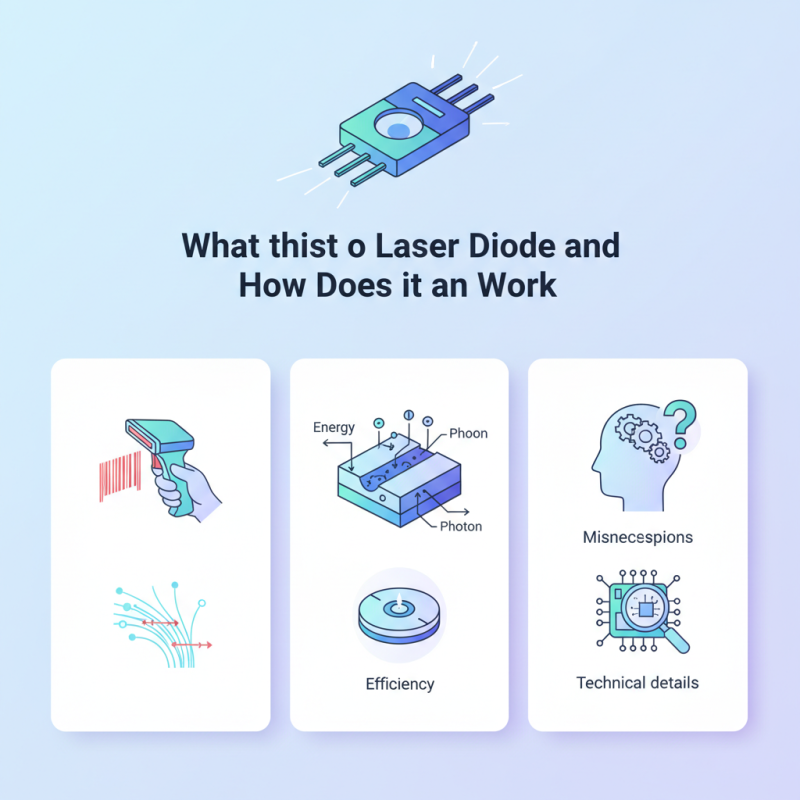
Unlike traditional lasers, laser diodes are compact and efficient. They utilize semiconductor materials to emit light, making them versatile and widely applicable. Their ability to produce coherent light is what sets them apart from other light sources. From barcode scanners to fiber-optic communication, laser diodes are everywhere.
However, despite their widespread use, there can be misconceptions about their operation. Not everyone understands the technical details of laser diodes. This complexity can lead to confusion and misapplication. A deeper look into their mechanism reveals both their strengths and limitations. It's essential to grasp these details to appreciate their true potential in our daily lives.
What is a Laser Diode?
A laser diode is a semiconductor device that emits coherent light when an electric current passes through it. Unlike traditional light sources, which scatter light in multiple directions, laser diodes produce a concentrated beam. This phenomenon results from electron-hole recombination in a specific material structure, releasing energy in the form of photons.
The construction of a laser diode involves layers of semiconductor materials. These layers create a p-n junction, where positive and negative charges interact. When energized, electrons drop to lower energy levels, emitting photons. This process can be intricate and requires careful engineering to achieve specific wavelengths and efficiency. Despite advancements, producing laser diodes remains a challenging task for researchers.
In various applications, laser diodes are indispensable. They are found in optical drives, fiber optics, and medical devices. However, developing more efficient diodes is an ongoing challenge. Researchers must consider thermal management, longevity, and cost-effectiveness. With the rapid evolution of technology, the demand for improved laser diodes grows. Understanding their fundamentals is crucial for engineers and scientists alike.
Basic Principles of Laser Diode Operation
A laser diode is a semiconductor device that generates light through a process called stimulated emission. It is similar in structure to a regular diode but incorporates a laser-active medium. This medium produces coherent light when an electric current is passed through it. The light emitted is tightly focused, allowing for high-intensity output.
The operation of laser diodes relies on several fundamental principles. When electrons recombine with holes in the active region, they release energy in the form of photons. This process occurs in a specially designed region that has a high electron concentration. As the photons bounce back and forth between mirrors at either end of the diode, they stimulate the emission of additional photons, amplifying the light output. According to a report by the Markets and Markets research firm, the global laser diode market is projected to reach $1.15 billion by 2026, indicating a growing application across industries, from telecommunications to medical devices.
In practical applications, efficiency remains a concern. Although these diodes produce a lot of light, they also generate heat, which can impact performance. Effective thermal management is crucial for maintaining optimal operation. Many researchers are exploring advanced materials and designs to enhance efficiency and reliability. This ongoing innovation reveals both the potential and the challenges inherent in laser diode technology.
Components of a Laser Diode
A laser diode is a vital component in various optical technologies. Understanding its structure enhances insights into its functionality. Primarily, a laser diode consists of a p-n junction made from semiconductor materials. This junction is crucial for electron-hole recombination, which generates light. Reports indicate that semiconductor materials like gallium arsenide are frequently used due to their efficiency in photon emission.
Another significant part is the optical cavity, which amplifies light produced by the recombination process. This cavity usually has mirrors on both ends, reflecting light in a coherent beam. According to industry studies, about 60% of the overall performance of laser diodes is attributed to this design. However, this amplification can also introduce noise, which sometimes requires careful engineering to mitigate.
The electrical contacts facilitate the current flow necessary for the operation. These contacts influence the thermal management of the laser diode, impacting its overall reliability. Recent data suggest that up to 25% of laser diode failures stem from overheating. This highlights a crucial area for improvement in thermal management techniques. Such challenges remind engineers to continuously innovate in materials and design.
Types of Laser Diodes and Their Applications
Laser diodes come in various types, each designed for specific applications. One common type is the semiconductor laser diode. They are compact and efficient, making them suitable for consumer electronics. These diodes are used in devices like DVD players and laser printers. Their small size allows for integration into portable devices, yet their performance can vary based on manufacturing quality.
Another type is the fiber laser diode. These diodes provide high power and excellent beam quality. As a result, they are often used in industrial cutting and welding applications. The flexibility of fiber-coupled output enhances their usability in different environments. However, the setup can be complex, and expert knowledge is necessary for optimal performance.
Additionally, there are visible laser diodes, mainly used in laser projectors and lighting. These create vibrant colors and can easily grab attention. Yet, their longevity can be a concern. Users might find that maintenance becomes necessary sooner than expected. Evaluating the specific needs and potential drawbacks is important when choosing the right laser diode for any application.
Types of Laser Diodes and Their Applications
This chart displays the different types of laser diodes and their respective applications. Edge-emitting laser diodes are widely used, followed by vertical-cavity surface-emitting lasers, quantum cascade lasers, and distributed feedback lasers.
Advantages and Limitations of Laser Diodes
Laser diodes offer significant advantages in various applications, particularly in telecommunications and medical technology. One notable benefit is their efficiency. According to a report by the International Society for Optics and Photonics, laser diodes can convert more than 50% of electrical energy into optical energy. This high efficiency leads to lower energy costs, which is especially relevant in large-scale industrial applications.
However, laser diodes also have limitations. Their output power is often lower compared to other laser types, which can restrict their use in some high-demand scenarios. Additionally, they are sensitive to temperature changes. This can impact the performance and lifespan of the device if not managed correctly. Research from the IEEE reveals that thermal management is crucial for maintaining optimal performance in laser diodes, highlighting the need for effective cooling solutions.
The reliability of laser diodes is often questioned due to their degradation over time. Studies show that factors such as current density and operational temperature can influence their longevity. Understanding these limitations is essential for users to make informed decisions about employing laser diodes in their systems. Balancing these strengths and weaknesses is key to optimizing their usage across various fields.