

Who Are the Top Theater Seating Manufacturers in China?
China’s cinema market is large, but scale alone does not identify its best seating suppliers. The National Film Administration reported 54.9 billion yuan in box-office revenue and about 86,000 screens in China in 2023. The Motion Picture Association’s 2023 THEME Report recorded $33.9 billion in global theatrical box office. These figures show the reach of cinema exhibition; they do not measure seating quality or manufacturer performance. That distinction matters.
Choosing a Theater Seating Manufacturer requires more than comparing product photos or quoted prices. Buyers should examine seat dimensions, foam and upholstery specifications, frame construction, aisle and row layouts, installation support, and documented project references. Ask how the supplier handles samples, production tolerances, spare parts, and replacement upholstery. Details matter. A seat that looks suitable in a showroom may feel cramped after a two-hour screening. Rankings can also vary by project: a multiplex, performing-arts venue, and lecture hall have different needs. Public reports rarely provide comparable, verified performance data for individual Chinese manufacturers. So any “top” list should explain its selection criteria and distinguish confirmed facts from supplier claims. This guide uses that cautious approach, focusing on capabilities and evidence buyers can check, rather than treating one universal ranking as definitive.
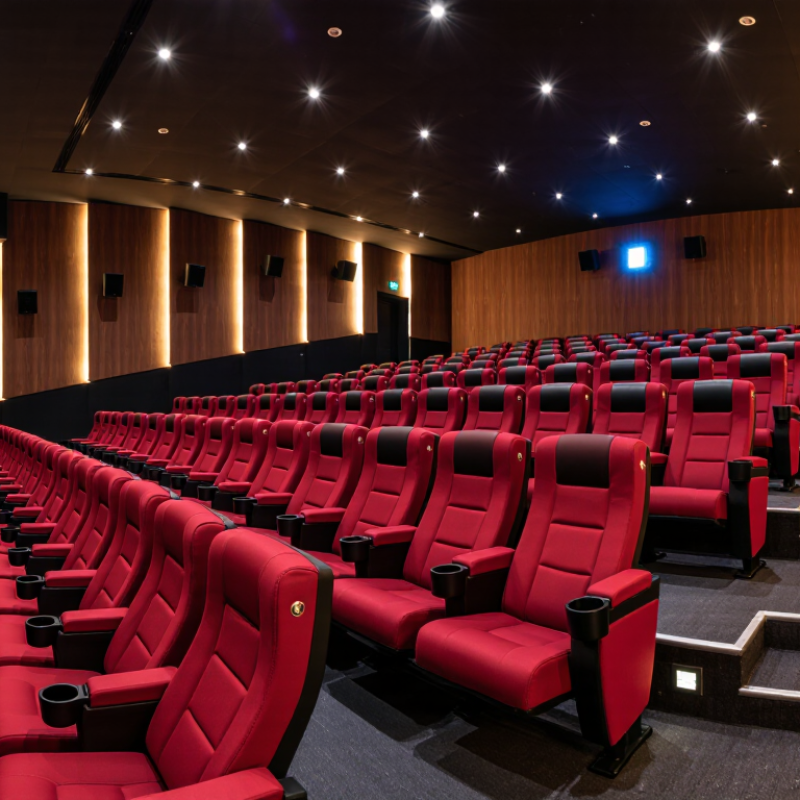
How China’s Theater Seating Manufacturers Are Compared by Production and Project Record
Comparing China’s theater seating manufacturers by production and project record takes more than counting factory machines. The National Bureau of Statistics reported that China’s furniture manufacturing sector generated RMB 655.7 billion in operating revenue in 2023. That figure covers all furniture, not theater seats, so it provides context rather than proof of a supplier’s capacity. Ask for theater-seat output by year, typical lead time, and documented quality checks. A clear production log beats a broad capacity claim.
Project records reveal how well a factory handles real venues. The China Film Administration reported 86,310 cinema screens nationwide at the end of 2023, indicating a large installed market, but screen counts do not verify seat installations. Request references for cinemas, auditoriums, or performing-arts halls, then check seat quantities, delivery dates, and post-installation service. Details matter. A dated installation schedule and photographs of aisle rows can help confirm execution, though photographs alone are not independent evidence.
For a fair comparison, review production figures alongside completed-project documentation and the factory’s process for replacements or repairs. Check whether quoted output reflects finished, inspected seats rather than unfinished frames. Ask how upholstery, hinges, and folding mechanisms are sampled during inspection. I would treat polished project lists cautiously until clients or project records can confirm them. This check is imperfect, but it makes the comparison more useful.
Leading Chinese Makers: Product Range, Installed Venues, and Customization Capacity
Chinese theater seating manufacturers vary in scale, but strong suppliers usually cover several product groups. These may include fixed auditorium chairs, retractable seating, lecture-hall seats, and VIP models. Compare frame construction, foam density, upholstery options, and aisle-end details, not just catalogue photos. Small details matter. A seat that looks comfortable can still feel cramped after a two-hour performance.
Installed venues offer useful evidence, but reference lists need context. Ask whether a supplier has completed theaters, school auditoriums, or multipurpose halls with similar capacity and use. Request project dates, seat counts, and permission to inspect a finished installation when possible. Customization may involve row spacing, floor slope, armrest design, fabric color, cup holders, and accessible seating layouts. Confirm which changes affect cost or delivery time. On some projects, buyers focus too much on appearance; that is an easy mistake. Review drawings, sample materials, and maintenance requirements before approving production. A careful comparison gives a clearer picture of each maker’s real capacity.
Who Are the Top Theater Seating Manufacturers in China? — Leading Chinese Makers: Product Range, Installed Venues, and Customization Capacity
An anonymized, category-based overview of Chinese theater-seat suppliers. It summarizes common product and project capabilities rather than ranking named companies. Venue examples are venue types, not claims about specific installations; confirm each supplier’s references, certifications, and specifications directly.
| Supplier profile | Typical product range | Venue types served | Customization capacity | Details to verify before purchase |
|---|---|---|---|---|
| Full-range auditorium seating maker | Fixed auditorium chairs, tip-up seats, row seating, and options such as writing tablets or cup holders. | Theaters, cultural centers, school auditoriums, and conference halls. | Usually project-based: upholstery, colors, armrests, seat dimensions, row layouts, and aisle-end details may be specified to order. | Ask for drawings, material samples, fire-test documentation applicable to the destination market, and completed-project references. |
| Cinema seating specialist | Cinema chairs, rocker or recliner-style models, linked seating, and selected premium-seat configurations. | Multiplexes, independent cinemas, and screening rooms. | Options may include upholstery, seat width, center consoles, power features, and configuration for the venue’s floor plan. | Confirm recliner mechanisms, electrical requirements where applicable, maintenance access, warranty terms, and replacement-part availability. |
| Retractable seating system supplier | Fixed and telescopic platforms with integrated seating; configurations vary by system and venue design. | Multi-purpose halls, school gyms, performance spaces, and venues requiring retractable tiers. | Typically requires coordinated design for platform dimensions, aisle access, seating layout, operating method, and site conditions. | Request structural calculations, operating and safety documentation, installation requirements, and confirmation of local code compliance. |
| Custom upholstered seating workshop | Upholstered auditorium chairs, wood- or metal-trim options, and made-to-order seating details. | Performing-arts venues, lecture theaters, cultural facilities, and renovation projects. | Can often tailor fabric or vinyl, color, foam, seat and back shapes, arm finishes, and selected dimensions; feasibility depends on the model. | Approve physical samples and a signed specification schedule; check cleaning guidance, upholstery durability, and production tolerances. |
| Value-focused project supplier | Standard fixed chairs and commonly requested auditorium-seat configurations. | Community venues, educational facilities, smaller theaters, and budget-led projects. | Customization is generally selected from available models, finishes, fabrics, and accessories; non-standard changes should be confirmed in writing. | Compare the complete delivered scope, including packing, installation, spare parts, lead time, and after-sales service. |
Note: These profiles describe supplier categories, not verified rankings or individual manufacturers. Installation claims, product availability, customization limits, and compliance vary by supplier and project.
EN 12727:2016: Four Test Levels for Fixed-Seat Strength and Durability
When comparing theater seating manufacturers in China, ask how each fixed-seat design performs under EN 12727:2016. The European standard defines four test levels for ranked seating, with requirements covering strength and durability. That four-level structure is useful procurement data, not a league table of suppliers. A higher level indicates a more demanding test category, but buyers should match it to the venue’s actual use.
Ask for test reports identifying the tested model, configuration, level, and laboratory. Check details such as seat-pan movement, backrest loading, and whether fasteners loosen after repeated testing. Small differences matter: an armrest, floor fixing, or upholstery change may affect the tested configuration. CEN’s EN 12727:2016 is the technical source for these four levels and their test methods. A brochure claim is not equivalent to a traceable report. Not just paperwork.
For a busy auditorium, review the selected level alongside expected occupancy, cleaning routines, and maintenance access. Ask whether test specimens represent the production seat, not a specially prepared sample. Also inspect failure notes; passing results can still reveal wear points worth monitoring. A supplier’s response to those details can be as informative as the result itself. One limitation remains: a laboratory test cannot fully reproduce years of varied audience use.
Fire-Safety Benchmarks: EN 1021-1 Cigarette and EN 1021-2 Match Tests
When comparing theater seating manufacturers in China, ask how each upholstered seat is assessed against EN 1021-1 and EN 1021-2. The first test uses a smoldering cigarette; the second applies a small flame representing a match. Both examine whether the upholstery assembly ignites or sustains smoldering under specified conditions. They are useful benchmarks, not proof that a chair is fireproof.
Details matter. A test report should identify the tested cover, foam, and any interliner, because changing one layer can alter performance. Ask whether the production seat matches the tested construction, including seam placement and material thickness. Request the report, its date, and the laboratory details. Then compare those records with the actual specification, not just a product photograph. Small changes can matter. A fabric finish or replacement foam may mean the tested result no longer describes the delivered seat. That point is easy to overlook. Buyers should also clarify how material substitutions are controlled during manufacturing and whether updated test evidence is available when the build changes. EN 1021 tests cover specific ignition sources; they do not measure every fire scenario in a theater. A careful supplier discussion should leave room for uncertainty, rather than promising more than the test can show.
Fire-Safety Benchmarks: EN 1021-1 Cigarette and EN 1021-2 Match Tests
Each test evaluates upholstered seating against one specified ignition source: a smouldering cigarette or a match-flame equivalent. The chart shows test-source coverage, not manufacturer performance or a pass rate.
These are separate test methods with pass/fail outcomes; results apply to the tested upholstery construction and should not be interpreted as a ranking of seating manufacturers.
Acoustic Performance: How ISO 354 Measures Sound Absorption in Seating Materials
A seat can look soft yet absorb little sound. Upholstery, foam density, seat shape, and gaps beneath the cushion all affect performance. ISO 354:2003 measures sound absorption in a reverberation room by comparing reverberation times with and without the test sample. The standard specifies a room volume of at least 150 cubic metres, helping create controlled conditions for comparison.
For theater seating, test results are more useful when reported as equivalent absorption area per seat across octave bands, rather than as a single material rating. A thick fabric may absorb more high-frequency sound, while low-frequency performance can remain modest. Small details matter. Hinges, exposed frames, and tightly packed rows may change how sound reaches the upholstery. ISO 354 does not, by itself, predict how a finished auditorium will sound; room geometry and occupancy also matter. That limitation deserves attention.
When reviewing supplier data, ask whether testing covered a complete seat or only a fabric sample, and request the test configuration and frequency results. These details help buyers compare products fairly. They do not guarantee identical results in every venue. A careful specification should treat lab figures as evidence, not a promise.